
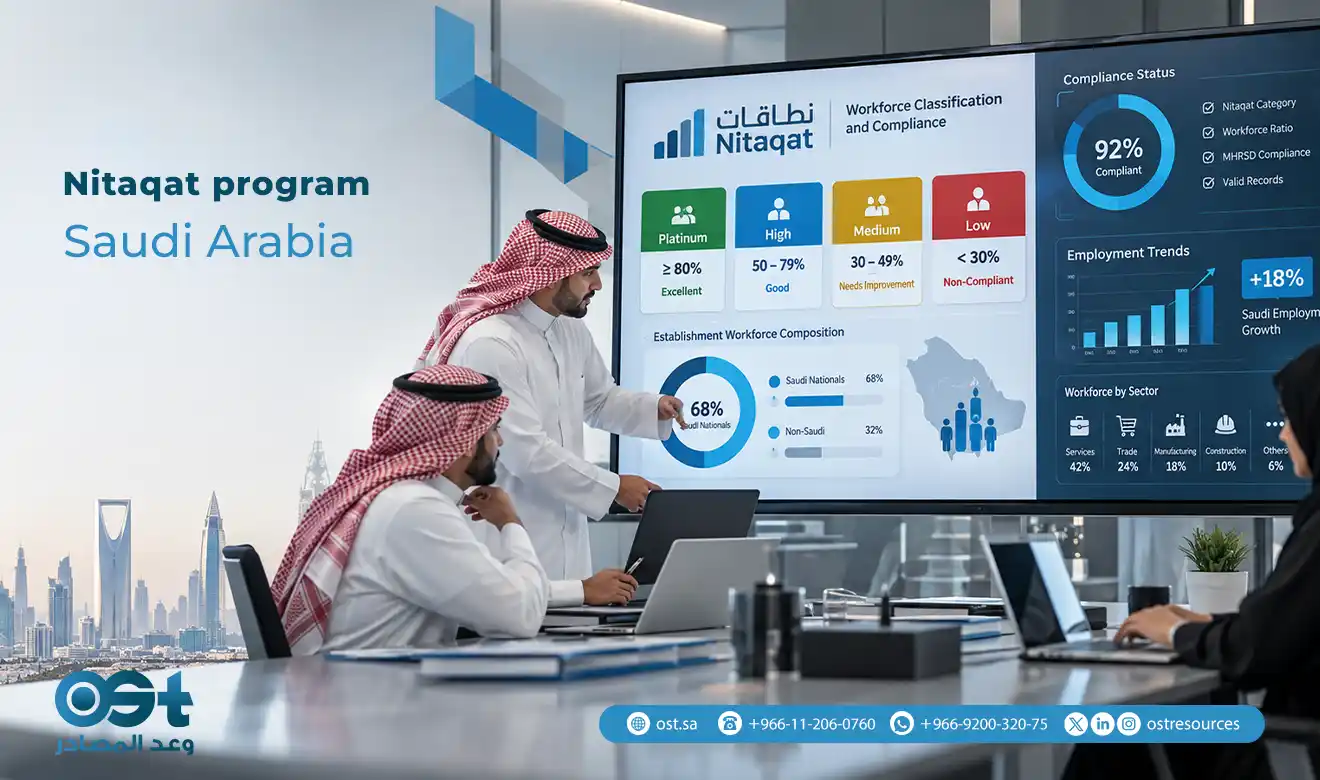
Comprehending the laws regarding employment is crucial for any business in Saudi Arabia. Businesses need to control recruitment, staff documentation and the workforce planning process, as well as comply with relevant Saudization regulations. The Nitaqat program Saudi Arabia is a vital element in this process as it analyses private sector institutions based on the number of their Saudi employees. The classification of a company may impact the availability of access to some of the services provided to workers and may have an impact on the employment choices of a company. Having a clear understanding of the program is useful for employers to determine staffing needs, set up hiring strategies and keep accurate track of staff. Businesses that need recruitment, workforce outsourcing and HR services to help them organize their workforce and manage employment needs can benefit from OST.
What Is the Nitaqat Program Saudi Arabia?
Saudi Arabia’s Nitaqat program is one of the government’s initiatives to promote the recruitment of Saudi nationals and to provide employment opportunities to citizens in the private sector.
Establishments are assessed based on the Saudization criteria in the program. The framework does not apply a single requirement to all businesses; it takes various factors into account, including economic activity and business size, when deciding on which requirements to apply.
The new Nitaqat program, launched in 2021, aimed to address workforce localization and provide a framework for businesses to plan their recruitment and employment. The Ministry announced in February 2026, a new period of three years for localizing over 340,000 more jobs for Saudi men and women in the private sector.
The Nitaqat program Saudi Arabia is more than just a recruitment hotspot for employers. It’s a workforce management issue that can affect hiring, employee records and eligibility for some government services.
Each business needs to check the most recent official guidelines for their business and not assume based on the percentage estimates.
How Does the Nitaqat Classification System Work?
The Nitaqat classification system is based on the requirements of Saudization that apply to the business activity and the size of the establishment. It is a classification that is based on the perspective of how the workforce relates to the corresponding localization criteria. Employers should be aware that the number of Saudi employees is not the only criterion for determining classification. Also, the relevant calculation method and the category of the establishment, as well as the existing regulatory requirements, are relevant. The classification system has performance bands that distinguish establishments on the basis of their localization results. The precise levels and consequences would be verified with up-to-date Ministry advice and the official record of the establishment.
Classification consideration | What employers should understand |
Economic activity | Different business activities may have different localization requirements. |
Establishment size | Workforce size can affect the applicable classification criteria. |
| Saudization rate | The proportion of eligible Saudi employees is an important factor. |
Employment documentation | Accurate, documented employment relationships support reliable calculations. |
| Applicable regulations | Current rules and sector-specific localization decisions must be reviewed. |
Businesses should monitor their official classification through the relevant government services and review changes whenever staffing levels or employment records change.
Understanding these factors helps employers use the Nitaqat program Saudi Arabia as part of their workforce planning instead of responding only after a classification problem appears.
Nitaqat Program Saudi Arabia and Saudization Requirements
Workforce localization (Saudization) is the term given to policies that encourage more Saudi nationals to work in the private sector. This is achieved by the Nitaqat framework, which ties establishment categorization to localization achievements.
Employers need to be aware that, in addition to general Nitaqat requirements, there are also further localization decisions that relate to certain professions or industries.
The Ministry, for instance, announced in January 2026 new localization requirements for some engineering and procurement professions. The decisions illustrate the need for businesses to verify both their classification and any specific rules for their activities.
Employers are advised to take into account the following responsibilities:
- Determine their location needs when establishing and practicing their profession.
- Discuss existing Saudiization goals and dates of implementation.
- Identify Saudi candidates for appropriate roles with regard to their identity and skills, according to the actual needs and specifications of the roles in the business.
- Keep employment contracts and employee data up to date.
- Check on other professional localization requirements, if any.
- Keep an eye on the official announcements from the Ministry that could alter the regulations.
The Nitaqat program should, therefore, be part of consideration with other relevant employment requirements rather than a replacement for them in Saudi Arabia.
When the meaning of a particular rule is not clear, businesses are encouraged to seek professional advice and to refer to official guidance of the MHRSD for guidance on compliance planning.
How Workforce Composition Can Affect Nitaqat Classification
An establishment’s workforce composition may have an impact on the level of Saudization. Localization rates may be affected by changes in the number of employees, their employment status, and their employment documentation.
For instance, an expanding company can hire more employees than it can add to its Saudi recruitment pool. This difference can cause stress for its localization service if there is no recruitment plan.
Likewise, when employees leave, the ratios can alter due to changes in the workforce, and when personnel records are not fully completed, discrepancies can occur between the ratios the company reports internally and the official ratios.
Employers should review on a regular basis:
- Numbers of Saudi and non-Saudi staffs.
- Predictions and projections of employee needs.
- Employee turnover and hiring needs.
- Documentation of contracts and employment.
- Any position subject to separate localization decisions.
- Department and/or establishment changes in workforce structure.
The Ministry’s announced methodology to calculate Saudization rates since May 2026 has been based on the employment contracts electronically documented on the platform called ‘Qiwa’. Employers should ensure that relevant Saudi employees’ contracts are properly documented and review the official guidance for implementation details exists.
A proactive approach to the Nitaqat program in Saudi Arabia helps HR teams identify potential staffing gaps before they disrupt workforce planning.
What Employers Should Monitor to Maintain Compliance
Ensuring that an appropriate Nitaqat classification is continuously monitored, not a single review. HR procedures should be set up regularly and individuals should be responsible for monitoring HR data and regulatory changes. Useful monitoring activities that are useful are:
- Check workplace data regularly: Check employee records, payroll, and recruitment reports for inconsistencies.
- Track Recruitment Needs: Predict the Saudi labor force required to support business growth and relevant localization targets.
- Ensure employment contracts and relevant employee information are up-to-date in the required official systems.
- Keep an eye on regulatory announcements: Review changes in Nitaqat calculation, sector-based Saudization and professional localization requirements.
- Co-ordinating HR and operations: Co-ordinating recruitment with project schedules, operational need and compliance requirements.
- Check classification changes:Do check out unexpected changes and see if it’s linked to headcount, documentation or changed requirements.
These practices help businesses make better workforce decisions while reducing the likelihood of avoidable administrative problems. The Nitaqat program Saudi Arabia should form part of a broader HR monitoring process that includes recruitment, employee documentation, and workforce forecasting.
Workforce and Saudization Support From OST
OST provides recruitment, workforce outsourcing, and HR-related services to businesses across Saudi Arabia. These services can help organizations manage staffing requirements, coordinate recruitment activities, and organize employee-related processes. For companies reviewing their approach to the Nitaqat program in Saudi Arabia, workforce support may be useful when internal HR teams need assistance with recruitment planning or changing staffing demands. OST’s workforce-related solutions include:
- Recruitment and staffing: Support with identifying candidates for relevant business roles.
- Workforce outsourcing: Staffing arrangements based on agreed operational requirements and contractual responsibilities.
- HR administration: Assistance with employee records, attendance, leave, and payroll coordination, depending on the agreed service scope.
- Workforce planning: Support with aligning staffing needs with business activities and projected demand.
- Operational staffing: Assistance with workforce requirements for ongoing operations and projects.
These services can help businesses organize recruitment and employee administration. However, Nitaqat classification depends on the applicable official rules and the establishment’s recorded workforce data. Employers remain responsible for confirming their obligations and should verify the classification impact of any proposed staffing arrangement. By combining structured workforce planning with regular HR reviews, businesses can make more informed recruitment decisions and respond to changing operational requirements.
Contact Us
Need support with recruitment, workforce planning, or HR administration in Saudi Arabia? Contact us to discuss your staffing requirements and explore workforce solutions suited to your business. Visit OST’s contact page to learn more about its services