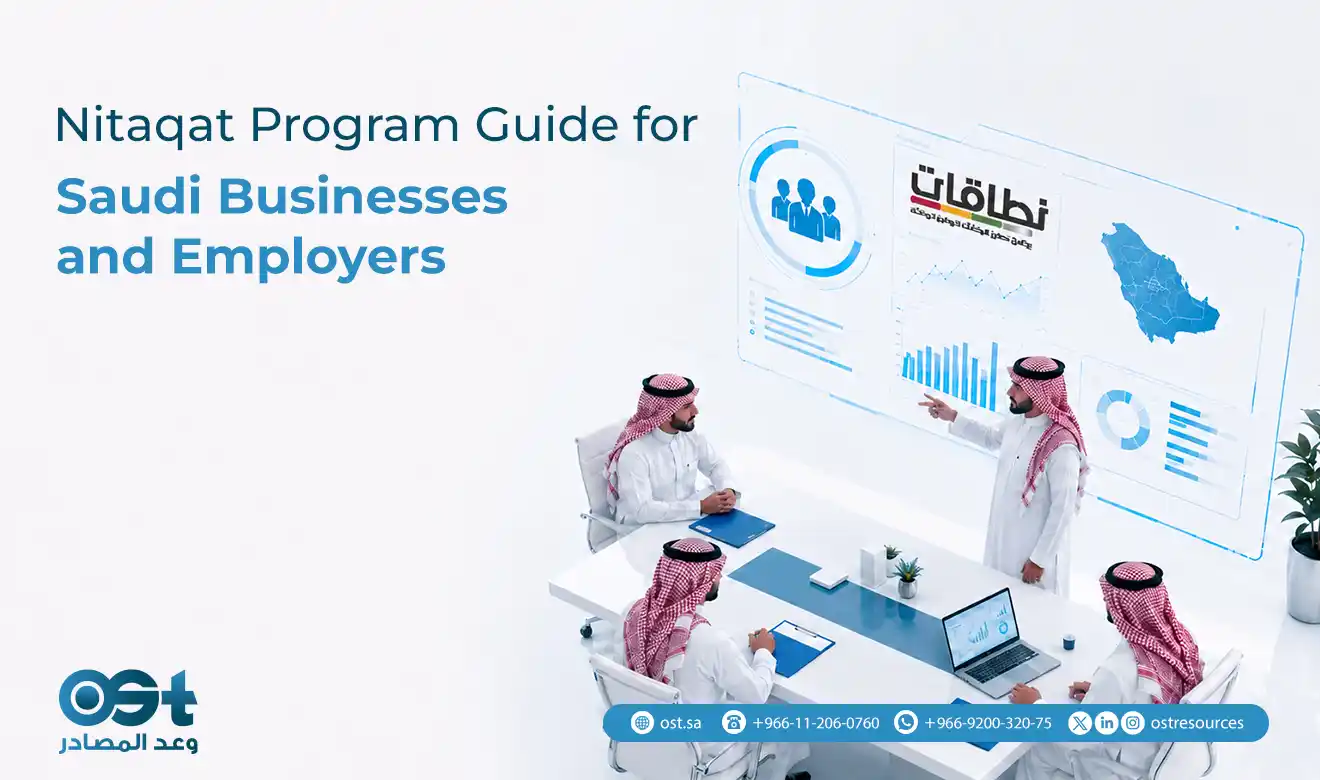
The Nitaqat program is one of the most impactful employment initiatives in Saudi Arabia aimed at boosting Saudi nationals’ involvement in the private sector. The program aims to support businesses to create a balanced workforce and to enhance citizens’ employment opportunities as part of the Kingdom’s Vision 2030. Businesses doing business in Saudi Arabia should know the program and its implications for their classification, which can impact access to government services and flexibility in operations. The Nitaqat Program is not only a legal obligation for employers but also increasingly a strategic business priority. Companies that effectively integrate their workforce plans with the Saudization criteria are more likely to grow, recruit, and run their businesses smoothly.
What Is the Nitaqat Program and How Does It Work?
Nitaqat is a classification framework that was launched by Saudi Arabia’s Ministry of Human Resources and Social Development (MHRSD) to assess the level of utilization of Saudi nationals in companies in the private sector. The program does not impose the same criteria on all business entities but is rather based on industry, size of workforce, and Saudization percentage.
Every company is assigned a compliance category. The higher the category, the more operational benefits for the company, and the lower the category, the fewer government services available to the company.
Nitaqat Category | Compliance Level | Business Impact |
Platinum | Excellent | Maximum government privileges |
High Green | Very Good | Strong operational flexibility |
Mid Green | Good | Access to most labor services |
| Low Green | Minimum Compliance | Limited privileges |
| Red | Non-Compliant | Significant restrictions |
By providing a classification system that encourages employers to continue a sustainable workforce strategy and not opt for a ‘quick hire’ just to comply with regulations.
How the Program Impacts Private Sector Companies
The Nitaqat Program impacts almost every area of workforce management, including recruitment, retention of staff, business growth, and administrative processes. Compliance companies tend to face fewer obstacles when they are interacting with labor services, which enables them to concentrate on expansion and development instead of compliance obstacles.
Companies that have a higher Nitaqat classification may have the following advantages:
- Improved access to government services for labor.
- More flexibility in the process of employing employees.
- Simplification of the process for renewing work permits.
- Better company reputation with customers and associates.
- Improved long-term workforce planning.
Nitaqat status is regularly assessed, so companies must constantly be aware of the diversity of their staff members and not wait for compliance problems to emerge. Effective planning minimizes risks to the operation and contributes to sustainable growth.
Strategies to Improve Your Company’s Nitaqat Status
To enhance the company’s status in the Nitaqat Program, a structured approach is necessary, which involves workforce planning, recruitment, and retention. Raising the number of Saudi workers is not sufficient without long-term stability.
Typical steps in a practical improvement strategy are the following:
- Create a long-term, sustainable recruitment strategy by enlisting qualified Saudi nationals with the requisite skills that align with the business’s needs.
- Improve employee retention by fostering competitive workplaces, professional growth and development, and good HR practices.
- Regularly check workforce information to prevent compliance risks from having an impact on company classification.
Businesses that regularly assess their staff rather than respond to compliance shifts have a better chance of sustaining a higher level of compliance over time.
The Relationship Between Saudization and Nitaqat
Both Saudization and the Nitaqat Program have different objectives despite their strong linkage. Saudization is the national policy aimed at creating job opportunities for Saudi nationals, whereas Nitaqat is the measurement tool to assess the level of success that companies achieve in implementing the Saudization policy.
It is important to realize that compliance has more to do than just meeting numbers. Stable jobs, investment in human capital, and maintaining balanced staffing and employment policies for business needs and national targets are also important considerations for employers.
The Saudi labor market is undergoing an ongoing process of modernization, and companies that have made Saudization a long-term business plan are better equipped for future developments.
Recent Developments in the Nitaqat Program
The Saudi labor market is continuing to change, and the Nitaqat Program is continually updated to reflect and meet Vision 2030 goals. Areas of recent improvement include boosting workforce efficiency, fine-tuning compliance requirements, and helping to facilitate sustainable work in various sectors.
Recent developments include:
- New compliance regulations for different business categories.
- More seamless integration with online labor platforms.
- Improved classification of the workforce.
- Further expansion of Saudization programs.
- Long-term plans for localization with a target of generating hundreds of thousands of new jobs in the private sector over the next several years.
These are steps that reflect the commitment that the government takes in developing a competitive labor market and promoting better strategic workforce planning on the part of employers.
Best Practices for Long-Term Compliance
The Nitaqat program is not a goal that can be accomplished once and for all, but rather a continuous business process. Organizations that regularly assess their employees and work on improving HR operations have a better opportunity of adapting to the changing rules.
Periodic workforce assessments is one effective way to try to maintain the required number of staffing levels through Saudization requirements. Businesses should also keep accurate employee records, regularly audit their recruitment plans, and ensure that their recruitment plans match their business growth.
Employee retention is also crucial. Hiring Saudi nationals with the necessary skills not only helps in achieving compliance but also boosts organizational knowledge, lowers recruitment expenses, and helps in ensuring long-term stability.
Compliance becomes part of the routine business practice, not a separate administrative function, which can enhance compliance performance and productivity.
Optimize Your Workforce Strategy with OST
OST can assist organizations in enhancing their workforce management practices by providing them with integrated administrative services such as the following:
- Human resource management
- Payroll services
- Recruitment support
- Job evaluation
- Organizational structure development
- The development of internal policy and procedure. Developing internal policy and procedure.
OST integrates administrative knowledge with contemporary HR solutions, assisting companies in optimizing their operations and guaranteeing adherence to Saudi labor laws.
Contact OST today to create a smarter workforce strategy that helps meet compliance requirements, optimize operations, and drive sustainable business growth.