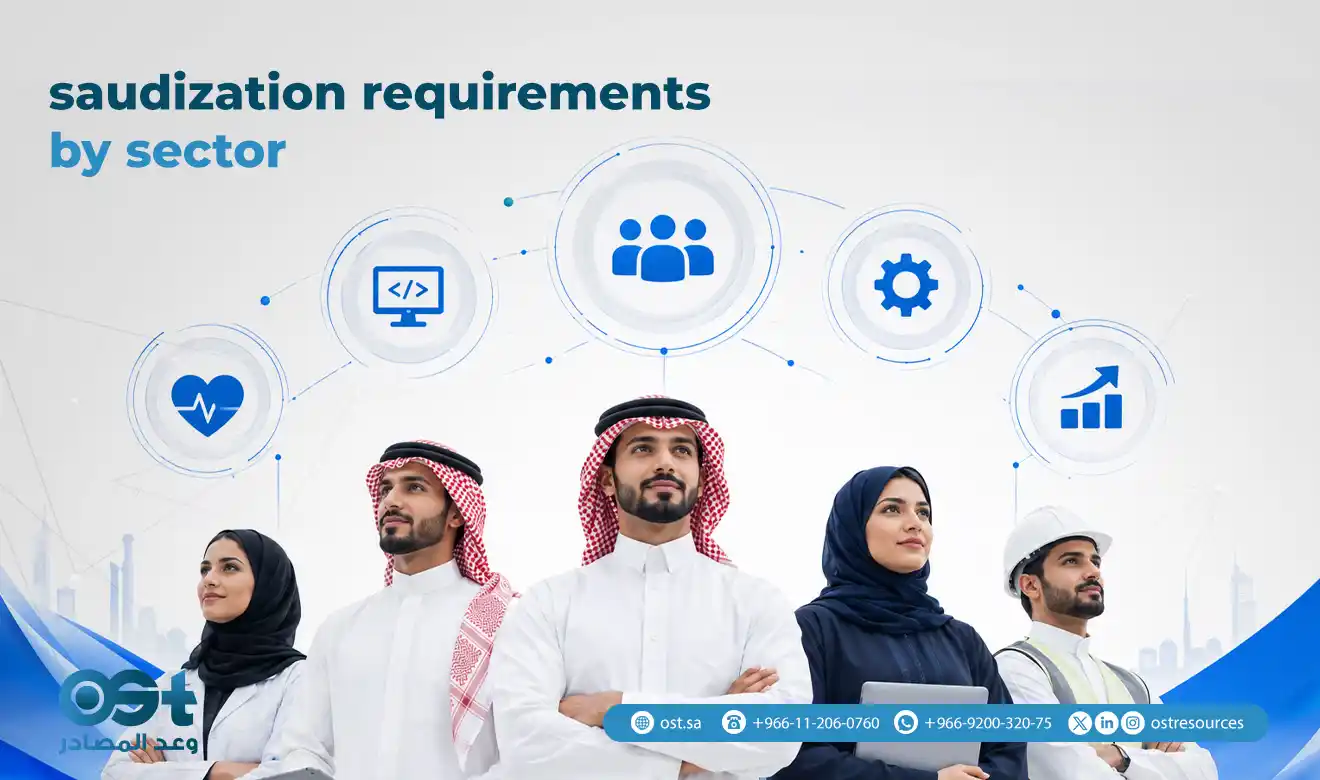
It is crucial for businesses in Saudi Arabia to comprehend the saudization requirements by sector. In an era where workforce localization is a key pillar of the Kingdom’s economic development, companies in various sectors need to meet industry-specific employment targets. The regulations are aimed at boosting the work participation of Saudi nationals and at promoting sustainable economic growth. The different industries have different localization targets, and organizations must have effective workforce planning, recruitment strategies, and HR solutions to comply with them. Knowing the Saudization requirements by sector can help businesses foster more resilient workforces, mitigate compliance risks, and contribute to their long-term success.
Saudization requirements by sector in Saudi Arabia
The term “saudization requirements by sector” is used to describe the segregation of the requirements for the local workforce in various sectors across Saudi Arabia. The requirements are set to ensure Saudi nationals are given employment opportunities in various professions and industry sectors.
The localization percentages may vary depending on industry, company size and workforce structure. Higher localization targets are set for some sectors due to its strong opportunities for local talent development, while others can be implemented gradually due to the need of specialized workforce.
Industries with the Highest Saudization Rates
There are several industries that have emerged as important focus areas for workforce localization initiatives. These sectors often have higher localization targets due to the availability of qualified Saudi professionals and the importance of local participation.
Typical industries with higher localization rates are the following:
- Financial services and banking.
- Human resources administration services and administrative services.
- Retail and customer service functions.
- Healthcare and medical support services.
- Information technology and digital services.
- Hospitality and tourism.
- Marketing and communications.
Saudization requirements by sector should be carefully monitored by organizations in these sectors, and workforce plans should be developed to ensure compliance with the objectives.
How Businesses Can Meet Sector Requirements
In addition to growing local employment, meeting the saudization requirements by sector requires more than that. Organizations must have organized workforce strategies that involve recruitment, employee development, and retention programs.
The first step is to carry out a workforce assessment to determine existing localization and staffing needs in the future. Then, the organizations should put in place measurable hiring goals consistent with industry standards.
Employee development is also a priority. Companies that invest in training, mentorship programs and career growth opportunities tend to have better localization results and improved employee retention.
Companies also need to regularly review employee performance to make sure that they are in line with evolving regulations.
Workforce Planning for Saudization Compliance
Workforce planning is a key component in supporting organizations to meet their Saudization requirements by sector. With good planning, companies can predict their future hiring requirements and meet their localization goals.
A comprehensive workforce plan normally involves talent forecasting, succession planning, recruitment scheduling, and employee development initiatives. These activities enable organizations to establish sustainable workforce structures that enable long-term growth.
The following table shows some of the important activities to consider for workforce planning to support successful compliance:
Workforce Planning Activity | Business Benefit |
Workforce Analysis | Identifies staffing gaps |
Talent Forecasting | Supports future recruitment |
Succession Planning | Develops future leaders |
| Employee Development | Improves workforce capabilities |
| Recruitment Planning | Supports localization goals |
| Retention Programs | Reduces employee turnover |
Companies with such activities as part of their workforce strategies tend to be better equipped to meet sector-specific localization needs.
Recruitment Strategies for Different Industries
Each industry has its own set of recruitment challenges – hence the need for tailored recruitment strategies. Companies that are aware of the requirements of the workforce in their industry are better positioned to create more effective recruitment strategies.
Effective recruitment strategies may encompass:
- Establishing good employer branding programs.
- Cooperation with universities and training institutions.
- Creating graduate recruitment programs.
- Leveraging recruitment agencies.
- Investing in staff development opportunities.
- Adopting long-term retention measures.
- Using technology for recruitment.
These methods enable companies to recruit the right Saudi nationals for their workforce and facilitate compliance with the saudization requirements by sector.
How OST Helps Companies Achieve Saudization Targets
The OST offers workforce and recruitment solutions to support organizations in meeting the Saudization requirements by sector. OST supports businesses with customized workforce planning, talent acquisition, and recruitment services to develop sustainable workforce strategies.
The company collaborates closely with clients to grasp the challenges unique to their industry and create tailored recruitment solutions that meet their operational goals. From the healthcare sector to the technology industry, retail to hospitality and beyond, OST offers practical workforce solutions to meet localization objectives.
With workforce planning and recruitment capabilities, OST enables businesses to enhance workforce performance and remain compliant.
Contact OST
Contact today to get customized recruitment and workforce solutions that help your business achieve Saudization targets, ensure compliance, and build a sustainable Saudi workforce
Staffing and HR Solutions for All Sectors
Organizations in almost all industries are impacted by workforce localization. Therefore, businesses need flexible staffing and HR solutions that can adjust to the evolving needs of their workforces and regulatory requirements.
The comprehensive support offered by OST is through:
- Recruitment and talent acquisition services.
- Staffing and forecasting.
- HR consultancy and compliance assistance.
- Employee onboarding solutions.
- Talent retention strategies.
- Leadership development programs.
- Succession planning initiatives.
These services support businesses to ensure compliance to Saudisation requirements by sector and enhance overall workforce efficiency and performance.
Why Businesses Choose OST for Recruitment Solutions
One reason why many organizations opt for OST is its ability to provide them with customized workforce solutions tailored to their specific industry needs. The company has experience in recruitment, workforce planning, and talent management, which assists clients in addressing recruitment difficulties and meeting their localization goals.
There are several important factors for businesses to consider when they choose OST:
- Industry-specific recruitment expertise.
- The availability of a skilled Saudi workforce.
- Tailored workforce planning solutions.
- Excellent knowledge of localization needs.
- Efficient hiring processes.
- Support for workforce development over a longer period of time.
These benefits allow companies to grow their workforce sustainably while complying with the specific industry regulations.