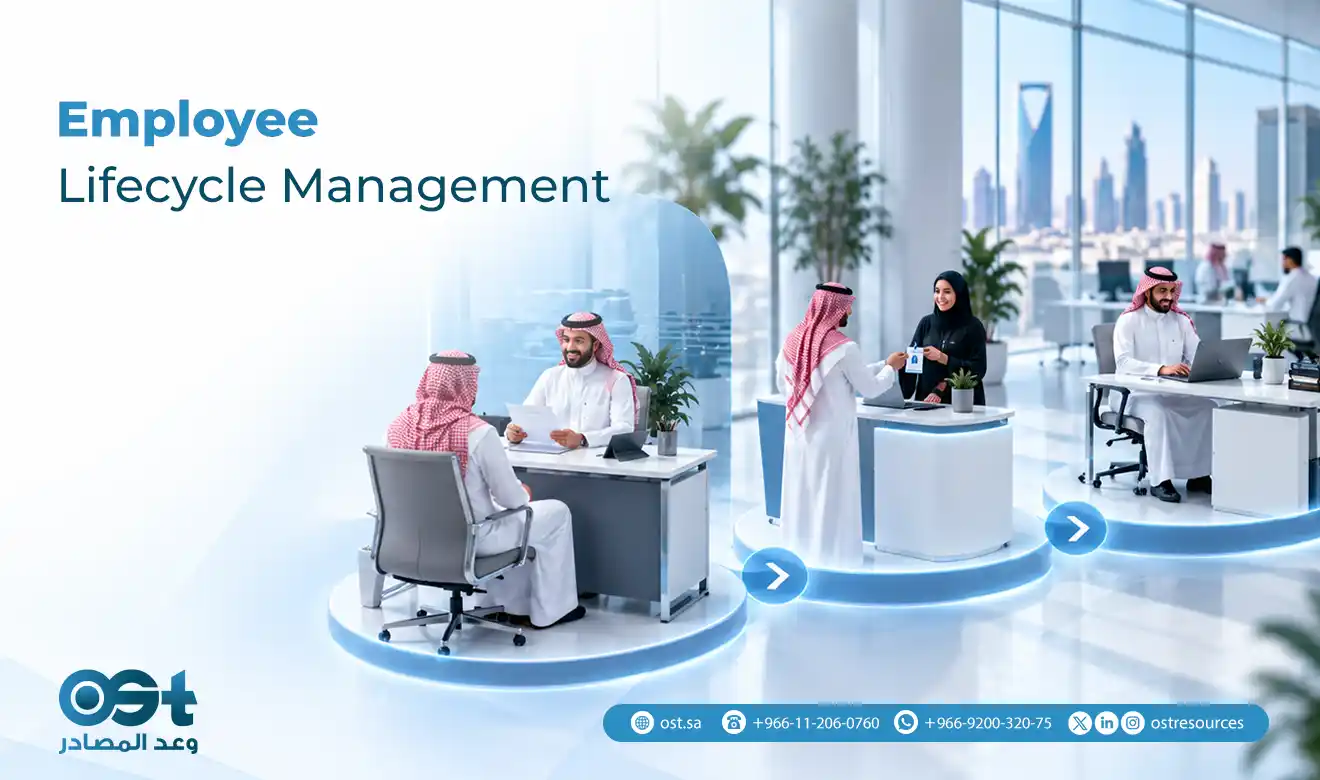
The employee comes into contact with an organization from the initial job announcement through the termination of employment. Companies can implement regular and structured interactions to develop uniform processes, enhance employee experience, and keep accurate workforce information. Employee lifecycle management is a method of managing an employee’s lifecycle stages from recruitment to onboarding, development, performance management, and offboarding. Using a structured approach can also help HR teams at organizations in Saudi Arabia plan for their workforce and manage HR on a day-to-day basis.
What Is Employee Lifecycle Management?
Employee lifecycle management is a systematic approach that organizations implement to manage the lifecycle of an employee from their recruitment to their separation. This idea is not about HR activities being disjointed administrative tasks, but rather it is a continuous process. The lifecycle usually starts with a need for staffing, followed by recruitment and onboarding, employee development, performance management, retention, and finally, offboarding.
A lifecycle approach can guide organizations to:
- Develop uniform HR practices
- Increase staff communication. Enhance communication among staff.
- Ensure accurate employee records are kept.
- Determine the need for workforce development
- Support performance reviews
- Organize employee transitions
- Enhance HR management coordination with management.
The sequence of stages can vary according to the size of the organization, its industry, its workforce make-up, and its internal HR policies.
The Key Stages of Employee Lifecycle Management
The employee journey can be segmented into a number of sequential phases. Each stage is understood and it helps HR teams to identify which processes, responsibilities, and records are to be managed.
Lifecycle Stage | Main HR Activities |
Attraction | Employer communication and workforce planning |
| Recruitment | Sourcing, screening, interviews, and selection |
| Onboarding | Documentation, orientation, and role introduction |
Development | Training, learning, and career development |
Performance | Reviews, KPIs, feedback, and development plans |
| Retention | Engagement, support, recognition, and workforce planning |
Offboarding | Exit procedures, documentation, and knowledge transfer |
These stages can be more efficiently linked together rather than managed separately through employee lifecycle management. For instance, data gathered during the recruitment process can help with induction, and feedback from a performance review can inform training needs.
HR systems and external service providers can also help organizations to coordinate between the various stages and manage repetitive processes.
Recruitment and Onboarding in the Employee Lifecycle
The initial step in the process of hiring new employees is recruitment. The general process of hiring begins with a job description, specification of the necessary skills, recruitment, screening, interviewing, and assisting in the hiring process.
Onboarding is another significant step after the selection of a candidate. It might include documents of employment, workplace policies, explaining expectations, explaining responsibilities and understanding workplace processes.
Good onboarding should provide employees with information to help them start their new job with clarity. It can also assist HR departments to maintain employment records and ensure that all necessary paperwork is kept in order.
It can be time-consuming to manage onboarding and recruiting manually for companies with many employees. Delegating specific HR tasks can be a great way to get some extra administrative help and free up time for the business team.
Seeking organized workforce and HR solutions in Saudi Arabia? OST will be able to streamline recruitment and employee management for your operational needs.
How to Manage Employee Development and Performance
Development and performance management are integral elements of the employee’s journey. If employees have been hired into their positions, there must be a process for tracking performance, giving feedback, determining skills gaps and assisting in employee growth.
A practical performance evaluation can consist of:
- Clearly established job roles.
- Defining measurable performance measures.
- Regular staff evaluations.
- Providing constructive feedback.
- Identifying training requirements.
- Making plans to develop or improve.
- Considering progress over time.
Offboarding and the Final Stage of the Employee Lifecycle
Offboarding is the last phase of the formal interaction between a company and its worker. It should be handled in the same way as recruitment and onboarding.
Offboarding can involve resignation or termination documentation, final administrative actions, asset returns, access changes, knowledge transfer, and exit interviews, which are all based on the situation.
A formal procedure is used to ensure that significant tasks are completed prior to separation. It also can assist organizations in keeping valuable operational information and keeping the appropriate workforce records.
Employees may be given an opportunity to share their experience in exit interviews. While there are some individual responses that may be interpreted in a variety of ways, there are common themes that may be helpful for HR teams to consider when looking for opportunities for improvement.
Simplify Employee Management With OST’s HR Solutions
All the phases of the employee lifecycle can be administratively intensive, especially for companies with expanding and distributed teams. HR outsourcing can offer extra support for certain activities and enable management teams to focus on their core business.
OST provides workforce and HR solutions that cater to the needs of the organization. It provides services like recruitment, HR management, workforce solutions, and operational support. Depending on the HR tasks that need to be outsourced, the model that suits organizations could be one task or multiple interrelated tasks. The right strategy hinges on factors such as company size, complexity, HR expertise, and goals. Discuss the type of HR and workforce services your organization requires with OST.
Contact OST
If your organization would like support in organizing its workforce processes, OST has tools and resources to help determine HR and operational needs for managing employees across the employment lifecycle.
External HR service providers can support organisations in many ways to deal with recurring activities in a more structured manner, from recruitment and workforce solutions to employee administration to performance-related processes. Contact us about your staffing needs and find appropriate HR solutions for your company in Saudi Arabia.